November 2, 2024
International Event
Revolutionary Marxism and War
Excerpts from the speech by Carlos Munzer,
from the Editorial Committee of the International Workers' Organizer
“Only the working class of Palestine, Middle East and internationally, with the civil war method, expropriating the businessmen and merchants of death can secure the victory of the war against the Zionist occupation”
It is impossible to talk about genocide in Palestine today without starting from the chain of revolutions in the Maghreb and the Middle East that broke out in Tunisia in 2011 and spread like wildfire throughout the region. But this chain of revolutions had a precedent. In 2008, the US army had to begin its withdrawal from Iraq. There was a huge class war, and it was waged by the Iraqi resistance in civil war and the working class of the central countries such as USA, Spain, France, England fighting against the war by confronting their own imperialist bourgeoisie. That is, the national civil war in Iraq was synchronized with the struggle of the proletariat of the imperialist countries.
At that time, the Aznar government of Spain carried out a self-attack at the Atocha railway station, blaming the “terrorists”. The next day there was a general strike... and not against the “terrorists”, but against the government. From there arose the cry of “the wars are yours but we put the dead!”.
In USA, mass mobilizations took place, such as the “Million Workers March,” Wall Street was besieged, and the ports of the West Coast were paralyzed. For every dead US soldier who returned to the USA, thousands took to the streets to avoid being killed for the sake of their imperialist bourgeoisie.
While this was happening, in 2008 a brutal economic crisis broke out, with all the stock markets and the big US banks collapsing. But not only that, as the European banks, which had 70% of their investments in Wall Street, were also hit by this crisis. They immediately emptied the treasuries of the European states to cover their losses and launched a brutal attack on the working class of the countries of the old continent to make up for the deficits. Thus, in 2008 and 2009, we saw a great wave of workers' struggles across Europe against the imperialist crash.
However, the economic crisis was not only in Europe and USA, it was a world crisis, comparable to the crisis of the 1930s, only this time it hit the heart of the dominant imperialism. THE latter threw its crisis at the world to make the colonial and semi-colonial world pay for it, which was met by enormous revolutionary uprisings against the imperialist crash.
The revolutionary uprisings in the Maghreb and the Middle East in 2011 were part of this revolutionary wave against the economic crash. Because the capitals that saw such a crisis in 2008 looked for something to increase their value, and they found it in the prices of agricultural produces, grains, etc., i.e., food commodities. This inflated the prices of food, and in countries where wheat is imported (like all Arab countries) the price of bread, the staple rose by 200% to 400% and the masses, having seen USA retreating from Iraq, said “Enough!” A chain of bread revolutions began that immediately clashed with fierce armored counter-revolutionary regimes, and the slogan was “the people want the fall of the regime.”
USA was beginning to lose its control over the Middle East
Thus, in 2011, from Tunisia to Egypt, Libya, Syria, Yemen, Bahrain, Iraq, Morocco and later Sudan, Lebanon, Algeria, etc., the masses overthrew ferocious autocracies that had for years guaranteed the plundering of oil by the Seven Sisters and held the borders of the Zionist state. The latter could not intervene for the risk of inciting the unifying of all the masses of the region against it. It was a huge revolutionary process that overthrew the US disciplining devices on the masses of the Middle East.
US imperialism, between the economic crisis and the mass uprisings, was beginning to lose its control over the Middle East and, through this, its hegemony in the world market. The European imperialist powers were entering different branches of production and areas of influence to do business, and were disputing them to USA. Germany, as imperialism, had emerged victorious from the reunification of '89 on a capitalist basis and managed to articulate a European market from Portugal to the Russian steppes, where cheap raw materials and slave labor were guaranteed by the maquilas in the former Warsaw Pact countries. In fact, there cannot be an all-powerful super-imperialism that dominates the whole world; there exist other imperialist powers, and in 2011 the masses burst in.
Reformism wants the older generation of the working class to forget and the new generation to not know how far we have come in the revolutions in the Maghreb and the Middle East, how the devices of imperialist domination were defeated, how they betrayed us and what to do when we go through a situation like this. They want us to forget that the most super-powerful army had to leave Iraq and Afghanistan, and that this was because of a national civil war synchronized with the struggle of the proletariat of the metropolises.
The class civil war that reformists hide
The chain of revolutionary uprisings in 2011 had several links, such as in Tunisia with a general strike and the seizure of police stations to free prisoners. Another link was Egypt, where industrial workers went on strike, closed the Suez Canal, and the masses in Cairo took Tahrir Square and established their power there. In Libya, the revolution went further, splitting up the army, conquering the weapons, setting up militias, reaching Tripoli and executing the dictator Gaddafi. No one doubts that what took place there was a civil war.
By civil war we mean in the sense proposed by Trotsky: “civil war constitutes a definite stage of the class struggle, when the latter, breaking the frameworks of legality, comes to be placed on the level of a public and, to a certain extent, physical confrontation of the forces present. Conceived in this way, civil war embraces spontaneous insurrections determined by local causes, bloody interventions by counter-revolutionary hordes, the revolutionary general strike, the insurrection for the seizure of power, and the period of liquidation of attempts at counter-revolutionary uprising.” (Leon Trotsky, Problems of Civil War, 1924, our bolds).
According to this definition, the Syrian revolution was also a process of civil war. It developed as a chain of insurrections from city to city. The base of the army was broken horizontally because women went to the barracks to find their sons, their husbands, their brothers who were under arms so that they would come over to the side of the people. Coordination Committees of workers and rank-and-file soldiers emerged, fighting to reach Damascus and destroy the government and the state of the oppressors.
In Yemen, the masses broke down the division between “Shiites” and “Sunnis” to win bread, understanding what the Paris Communard workers said in 1871: “He who has arms, conquers bread.” They also succeeded in splitting up the army, taking the capital, setting up their armed self-organizations… and this armament continues to this day, which is why they have given effective support to the Palestinian masses by interrupting trade in the Red Sea, stopping Zionist supplies and attacking the profits of the imperialists.
In Palestine, victory can be achieved applying
the method of proletarian revolution
What we are experiencing today in Palestine is a war against an invading occupier to liberate an oppressed nation. The entire imperialist press is asking why Zionism, which is the fifth most powerful army in the world, after a year and a month have passed, cannot finish taking the Gaza Strip, which has 2 million inhabitants crammed into just 360 square kilometers.
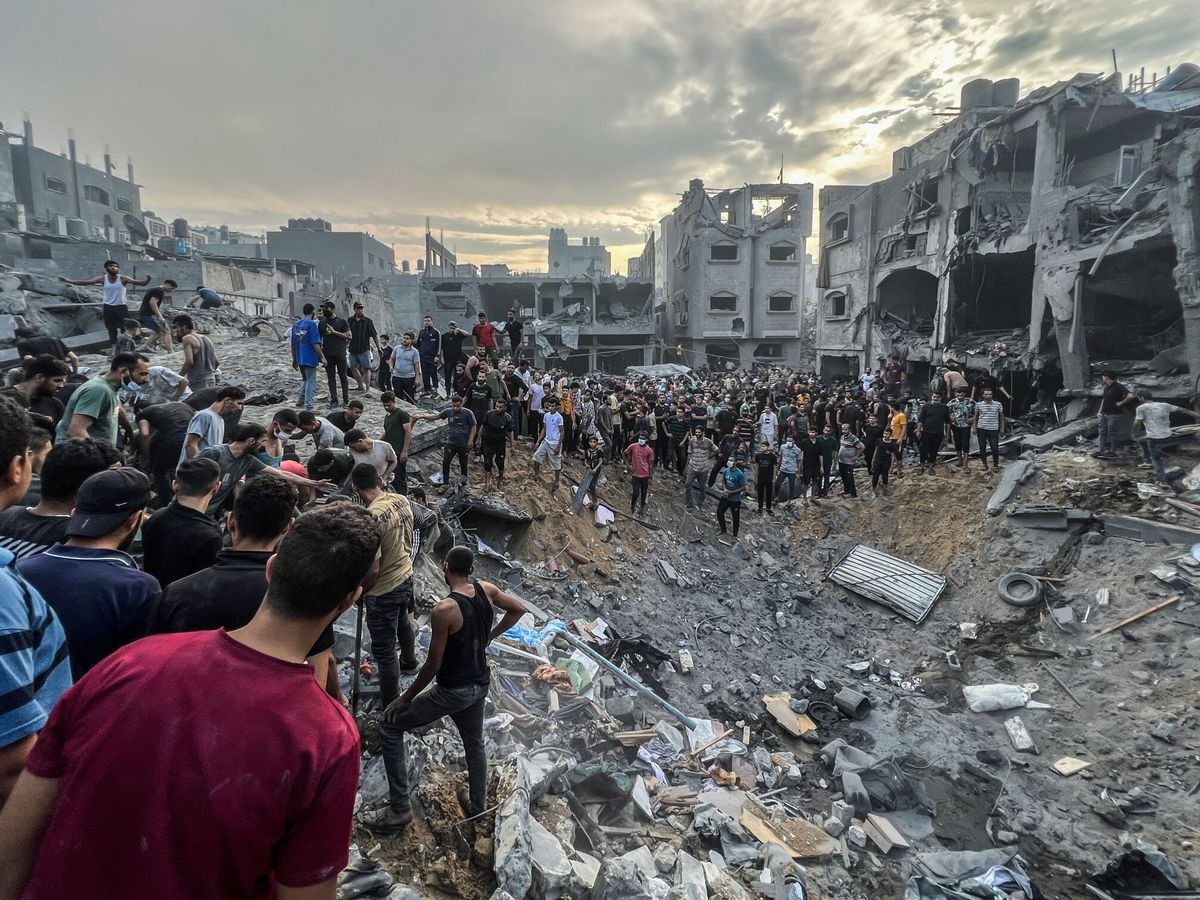
The thing is that Zionism can bomb, destroy entire cities, but if the infantry does not occupy the territory, they do not win it. And the answer is it has already become a class civil war, where it is the Palestinian masses of Gaza who are armed and resisting the invader.
Of course, the Palestinian masses have their own defense armies that were built up over the years to resist the occupation, such as Hamas, Islamic Jihad or the Popular Front for the Liberation of Palestine. These organizations do not recognize the state of Israel, unlike the bourgeoisie of the old PLO, the Palestinian Authority of the West Bank, which does recognize the Zionist state and has sold out the Palestinian people for a dime. This is because this PLO keeps a cut of the taxes that the state of Israel collects throughout the West Bank.
But in Gaza there is already a civil war. To give a graphic example of what we are talking about, the Zionists go around bombing Gaza with their planes and demolishing it with their tanks, but then they have to occupy and hold that territory… at night the soldiers find themselves face to face with the Palestinian workers whose children, parents, wives, brothers… have been killed and who are the ones who confront them with the armament of the masses.
The invader is strong from afar with a missile launcher or on top of an aircraft, but when it has to occupy territory, it enters into a civil war, which is the armed people fighting from under the rubble and who know every corner of the city they defend. This is what prevents Zionism from taking territory, added to the great ally that the Palestinian masses have, which are the millions of workers who are organizing and mobilizinh around the world to stop this killer hand.
We are on the same military front with the Palestinian resistance, recognizing its legitimate right to self-defense as an occupied nation to defend itself against the occupier. We are in favor of Hamas being declared a belligerent army and being sent weapons. But at the same time, we maintain our political independence. In the words of Trotsky in 1937, when an oppressed country like China was at war against the occupation of an imperialist country like Japan: “the duty of all the workers’ organizations in China was to participate actively and in the front lines of the present war against Japan, without abandoning, for a single moment, their own program and independent activity.” (On the Sino-Japanese War, Leon Trotsky).
This means that while we confront Zionism, we do so with the program of expropriation in order to provide all the resources so that the people can eat and win the war. We know that the bourgeoisie, that is, the leaders of the organizations defending the Palestinian masses such as Hamas or Islamic Jihad, guarantee that the masses do not attack the property of imperialism (especially US imperialism that commands Zionism) and of the capitalists, since their own property is also at risk.
We are in favor of the self-organization of the resistance and the election of its leaders. We are in favor of the creation of supply committees so that the people can eat.
While Hamas tries to negotiate and puts the Arab and Iranian bourgeoisies as its allies, we are in favor of the uprising of the working class with their massacred sisters and brothers in Gaza, for the opening of the fronts, for an international general strike and an attack on the property of imperialism and the bourgeoisie, in particular that of Wall Street, which commands the genocide.
For Marxism, the key is to define what is War for the proletariat, that is, how the class struggle continues in war. Moreover, in war, the class struggle becomes extremely acute. Reformism, on the other hand, talks about war and writes books and rivers of ink, but it hides the class struggle and the position of the proletariat in it.
Against them, the Fourth International, discussing war on the eve of the Second World War and in the midst of the Spanish Civil War, in 1937, in the work "Principles and Tactics in War" summarized by Rudolph Klement , stated:
“War is only the continuation of politics by other means. Hence the proletariat must continue its class struggle in war-time, among other things with the new means which the bourgeoisie hands it. (…)Recognizing the progressive character of this war of liberation, it (the proletariat) must fight decisively against the main enemy, reactionary imperialism (or else against the reactionary camp, in the case of a civil war), that is, fight for the victory of the socially (or politically) oppressed or about-to-be oppressed: USSR, colonial and semi-colonial countries like Abyssinia or China, or Republican Spain, etc.
Here too, however, it remains mindful of its irreconcilable class opposition to its “own” bourgeoisie -or its political opposition to the Soviet bureaucracy– and does not surrender without resistance any of its independent positions. As in the imperialist countries it strives with all its strength for the social revolution and the seizure of power, the establishment of its dictatorship, which, moreover, alone makes possible a sure and lasting victory over the imperialists. But in such cases, it cannot and does not seek, as in the imperialist camp, revolutionary victory at the cost of a military defeat but rather along the road of a military victory of his country.”
Far from the position of Trotskyism, the PTS said that what happened on October 7, 2023 was not a legitimate act of self-defense by an oppressed nation, and condemned it as “a ferocious terrorist attack by Hamas” and offered condolences to the occupier. This is a real infamy.
Over the past three years, Zionism had sent waves of settlers who were paid U$D 4,000 a month to go and occupy Palestinian land. Moving forward to occupied more land in the West Bank, in Palestinian neighborhoods of Jerusalem, expelling people from their homes, they were carrying out a new colonization of Palestine with heavily armed settlers who took Palestinian land, and raped and killed their daughters and sons. These settlers were celebrating in a rave party that they had come and stolen Palestinian land on October 7 last year.
The PTS gave them condolences and condemned the self-defense action against the occupation of Palestine. Then they disguise themselves as “being with the Palestinian people” or “for a socialist Palestine.” But they do not specifically say that they are on the military front against Zionism. They play hide and seek. Are they, yes or no, on the military front against Zionism? Or how do they plan to gain authority for a “socialist Palestine”? What would they do if a PTS movement were in Gaza today?
The revolutionary position, which the PTS tries to conceal, is the one expressed by Trotsky in the Spanish civil war in the 1930s: “wherever and whenever revolutionary workers are not powerful enough immediately to overthrow the bourgeois regime, they defend even rotten bourgeois democracy from Fascism, and they especially defend their own position inside bourgeois democracy.
The workers defend bourgeois democracy, however, not by the methods of bourgeois democracy (e.g., Popular Fronts, electoral blocs or governmental coalitions, etc), but by their own methods, that is, by the methods of revolutionary class struggle. Thus, by participating in the military struggle against Fascism they continue at the same time to defend their own organizations, their rights and their interests against the bourgeois-democratic government.” (Leon Trotsky, Against Defeatism in Spain, 1937, our bolds)
The obstacles facing the Palestinian masses to victory
The Palestinian masses are resisting heroically. The obstacle they face is the leadership. To win the civil war, the leadership of the proletariat must put forward a program of social reforms, of expropriation of the bourgeoisie, of telling the peasants “the land is yours” and the workers “the factories are yours”.
On the other hand, a bourgeois leadership prevents expropriation. In Trotsky's words: “Civil war, in which the force of naked coercion is hardly effective, demands of its participants the spirit of supreme self-abnegation. The workers and peasants can assure victory only if they wage a struggle for their own emancipation. Under these conditions, to subordinate the proletariat to the leadership of the bourgeoisie means beforehand to assure defeat in the civil war.” (The Lessons of Spain: the Last Warning, 1937, our bolds)
The Palestinian masses have already begun to outstrip their leadership, not only conquering widespread armament, but above all by starting to expropriate the food stores and shops of the Palestinian bourgeoisie's hunger merchants who sell food to the besieged and massacred hungry masses of Gaza.
But the task of expropriating and attacking the property of the capitalists is key throughout the Middle East. We must expropriate the oil wells of the Seven Sisters and the banks through which petrodollars are fled in Iraq, Iran, Saudi Arabia, Kuwait, Qatar, Syria, Lebanon, Libya and the entire region. That is why throughout the Maghreb and the Middle East we are facing the same battle against the same enemy.
The leadership crisis worsens
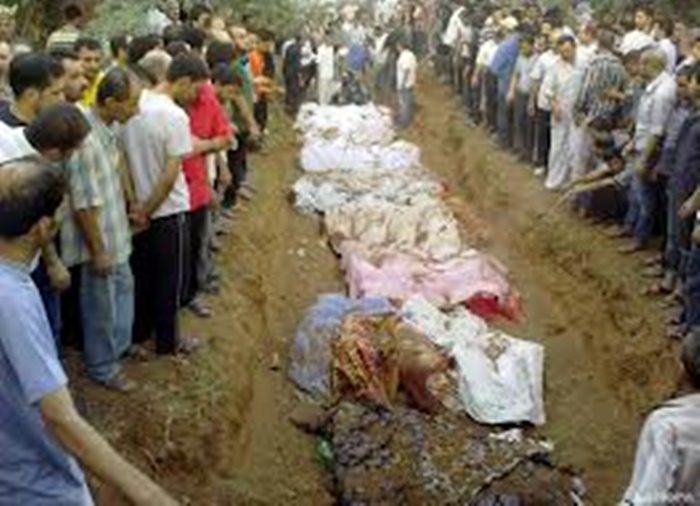
The second obstacle for the Palestinian masses to defeat the Zionist occupation is the treacherous leadership of the working class at the international level. At the end of the 19th century, workers went on general strikes worldwide for the Chicago Martyrs and the 8-hour work day. Today we cannot complete an international general strike, as the Palestinian unions called it, for the 600,000 workers killed in Syria and for the thousands and thousands massacred in Palestine and for the defeat of genocidal Zionism.
This is what Marxists call a crisis of leadership. Though there is mass support, the leaderships prevent a coordinated and centralized action.
In the Spanish Civil War of the 1930s, Trotsky in his work “For the Victory of the Spanish Revolution” expressed the importance of a revolutionary leadership in order to succeed in the civil war: “In civil war, incomparably more than in ordinary war, politics dominates strategy. Robert Lee, as an army chieftain, was surely more talented than Grant, but the program of the liquidation of slavery assured victory to Grant. In our three years of civil war the superiority of military art and military technique was often enough on the side of the enemy, but at the very end it was the Bolshevik program which conquered. The worker knew very well what he was fighting for. The peasant hesitated for a long time, but, comparing the two régimes by experience, he finally supported the Bolshevik side.”
The Palestinian masses have once again raised three motions, three key points for the world working class: First, an all-out war on Zionism, which it disavows. Second, it is a decisive battle from the Maghreb and Middle East revolutions of 2011. And third, they have exposed the betrayal of the leaderships.
The key is once again the revolutionary leadership, the return of Marxism, not as a “promise for the future” as reformism says, but as a present and immediate necessity. We need to recover the banners of the Fourth International, its revolutionary program and its legacy, by defeating reformism.
|

.jpg)